
September 19, 20266 min read
What Is a Loyalty Program? Types, Benefits and How to Start One
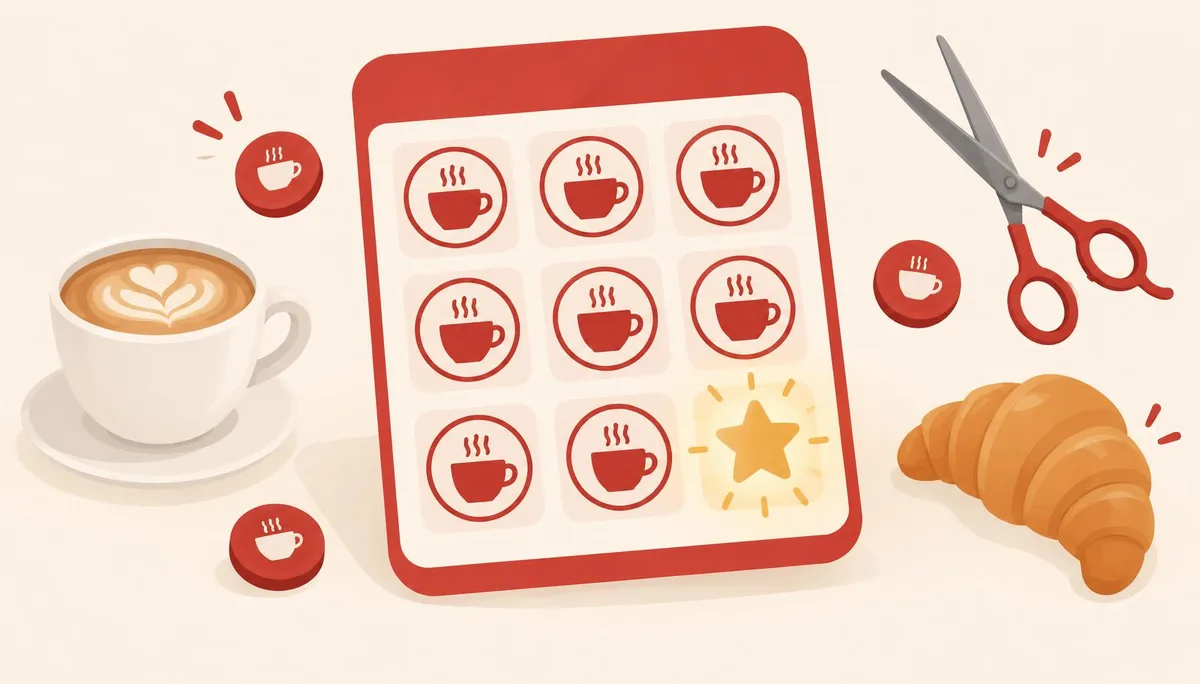
If you run a café, a barbershop, a bakery or a small shop, you know this moment: a customer walks in, loves what they got, and then you don't see them again for two months. Or ever. A loyalty program is one of the simplest ways to change that, and you don't need a big budget or a marketing team to run one.
What is a loyalty program?
A loyalty program is a system that rewards customers for coming back. The customer earns something each time they buy, usually stamps or points, and exchanges it for a reward once they reach a set goal: a free coffee, a discount, a free extra service.
The idea is old and simple, which is exactly why it works. "Buy eight, get the ninth free" needs no manual. Customers understand it in three seconds, and that matters more than any clever mechanic.
The main types of loyalty programs
Stamp cards. The customer gets one stamp per visit or purchase and a reward after a fixed number. Best for businesses with one repeatable product: coffee, a haircut, a lunch deal.
Points. The customer earns points based on how much they spend, for example 1 point per euro, and redeems them from a reward menu. Best when baskets vary a lot, as in restaurants, bakeries and retail. A 3 euro purchase and a 30 euro purchase should not count the same.
Tiers. Regulars unlock better rewards as they reach levels, like Silver and Gold. This works for big chains, but for a small local business it is usually too much to run and too much to explain.
Paid memberships. Customers pay a fee for permanent perks. It can work, but it needs a lot of trust and is rare in local business.
Referral rewards. A reward for bringing a friend. Good as an add-on, weak as the foundation.
For most small businesses, stamps, points or a mix of the two are plenty. Start with the simplest version you can explain at the counter in one sentence.
The benefits of a loyalty program
More repeat visits. A reward that is within reach gives people a reason to come back sooner and to pick you over the place next door. A customer on stamp 7 of 8 is not going to walk into another café.
Cheaper growth. Harvard Business Review has noted that winning a new customer can cost anywhere from 5 to 25 times more than keeping an existing one. The range is wide and the research behind it is older, so treat it as a direction, not a promise. Still, the logic holds for a small shop: ads and first-visit discounts for strangers cost more than a stamp for someone who already likes you.
Profit leverage. Bain & Company research by Frederick Reichheld suggests that a 5% improvement in retention can raise profits by 25% to 95%, depending on the industry. This is also an older study, so read it as a sign of how much retention matters, not as a forecast for your shop.
A direct line to your regulars. With a digital program you know who your regulars are, when each of them last came in, and who has gone quiet. You can send an offer to people who haven't visited in three weeks instead of discounting for everyone. A paper card can't do any of that.
Word of mouth. People who feel rewarded talk about it. A regular who tells a friend "go there, you get every ninth one free" is the cheapest advertising you will ever get.
Does it pay off? A quick break-even check
Take a barbershop. A haircut costs 20 euros, and the program gives a free haircut after 8 paid ones. That means 1 in every 9 haircuts is free, so the effective discount is about 11%.
Now say a regular currently comes 8 times a year and spends 160 euros. With the card, each visit is worth on average 17.78 euros instead of 20. To bring in the same 160 euros, that customer needs to visit 9 times a year instead of 8, exactly one extra visit to break even.
And that is the harsh version, because the free haircut doesn't cost you 20 euros. It costs chair time and a few supplies. If your chair is often empty anyway, the real cost is even lower.
A rule of thumb worth using: design the reward so that it costs you roughly 5% to 12% of what the customer spends to earn it. The barbershop above, at about 11%, sits near the top of that range, which is fine as long as chairs often sit empty anyway. Much lower and nobody cares. Much higher and you are just giving margin away.
Common mistakes to avoid
Setting the goal too far away. If it takes 20 visits to get a reward, most people never start. A typical regular should be able to reach the first reward within a few weeks to two months.
Making the rules complicated. If you need a paragraph to explain it, redesign it.
Relying on paper cards alone. People carry a wallet full of them and forget the one they need. Lost cards mean lost progress, and lost progress means lost customers.
Never telling anyone. A program nobody mentions at the till does not exist. Train your staff to say one sentence to every customer: "Want to join our loyalty card?"
Collecting data and ignoring it. If you can see that 40 of your regulars haven't been back in a month, send them something. That is where a digital program earns its keep.
Paper or digital?
Paper is cheap and fine for a very small start. But it gets lost, it can't be counted, and it tells you nothing about your customers. A digital card fixes all three: the customer scans a QR code, nothing to install, and both of you can see the progress.
If you want to see what that looks like in practice, here is how a digital loyalty card works from both the customer's and the owner's side. And on cost: many tools charge per location or per feature, so check what you actually get. CrabTap is a single plan at $8.99 per month with a free trial, and it is free for customers.
How to start this week
- Pick one repeatable product or service to base the reward on.
- Set the goal so a regular reaches it in about a month or two.
- Make sure the reward costs you roughly 5% to 12% of what the customer spends.
- Write the offer in one sentence and put it on the counter.
- Ask every customer for a week, then look at how many joined.
You don't need a perfect program on day one. You need a simple one that people actually use, and then you improve it with real numbers.
30 days free, no card required to start.