
You set up a loyalty program, printed the cards or put up a sign, and then not much happens. A few regulars use it, most customers never take the card out, and some never take one at all.
That's rarely a sign that loyalty programs don't work. It's usually a handful of small things at the counter. Here are seven fixes you can start on this week, most of them free.
Why customers don't use the card you gave them
People rarely say no to a loyalty card. They just forget about it. The usual reasons are simple:
- The card is in a drawer, in a wallet full of other cards, or at home.
- Nobody explained what they get, so there's no reason to care.
- The first reward feels too far away to bother.
- Joining took more effort than the reward was worth.
Each fix below targets one of these.
1. Give every customer a head start
In a well-known 2006 study by Joseph Nunes and Xavier Drèze, car wash customers received a card that needed eight paid washes for a free one. Some got a card with eight empty spaces. Others got a card with ten spaces, two already stamped. The effort and the reward were the same. Only 19% of the first group finished their card, compared with 34% of the second.
People are more motivated when they feel they've already started. So don't hand over an empty card. With paper, stamp it once before it leaves your hand. With a digital card, add the first stamp yourself right after the customer joins, and say it out loud: "You're already one stamp in."
2. Ask once, at the right moment, with one sentence
The best time to mention your program is when the customer is already paying or waiting for their order. They're standing there anyway, and it costs them nothing to listen.
Don't rely on a sign alone. Pick one sentence and make it the standard for everyone on your team: "Want a free coffee after your sixth visit? It takes ten seconds." A script helps the newest employee as much as the owner. Ask everyone, not just regulars, because first-timers become regulars when someone invites them. If they say no, that's fine. One ask per visit is plenty.
3. Make joining take seconds, not minutes
Every extra step loses people: downloading an app, filling in a long form. Keep it to a scan and a quick sign-up.
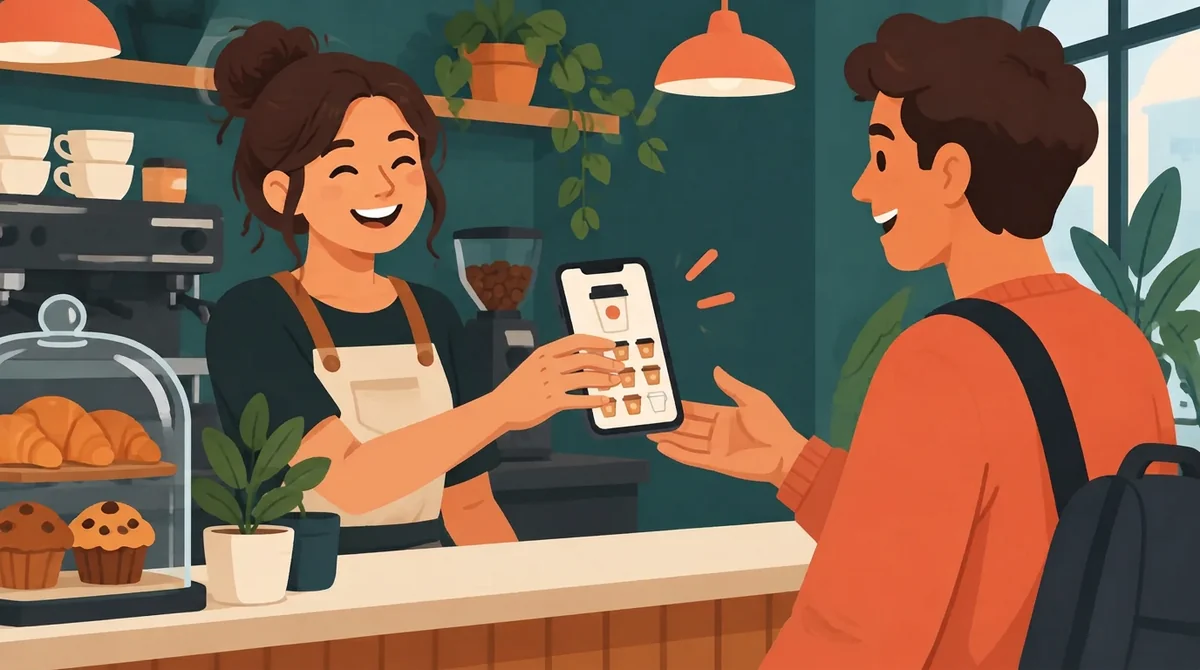
With CrabTap, the customer scans the QR code on your counter, signs up, and the card appears on their phone. There's no app store download. A customer who already has a CrabTap card can add your venue with a single scan. If you can't explain how to join in one breath, simplify it.
4. Keep the first reward close
A reward that needs fifteen visits feels like never. For a café or bakery, aim for a first reward within five or six visits. For a barbershop or salon, where visits are weeks apart, three or four is more realistic. Show progress at every visit: "two more and it's free" brings people back.
The reward doesn't have to be big. A free small item or a modest discount is enough, as long as it feels within reach and you can afford to give it.
5. Make the card easy to find
A card people can't find at the moment of paying doesn't get used. A digital card beats paper here, because the phone is already in their hand.
In CrabTap, every customer has one permanent personal QR code and member number. It can be saved to Apple Wallet or Google Wallet, or kept as an image. Tell people at sign-up: "It's saved on your phone, so you'll always have it with you."
6. Bring back people who drift away
Even happy customers drift. A short message after two or three weeks without a visit often works better than any ad: a small discount, a free extra, or just "we miss you."
Email reaches everyone. Push notifications reach customers who added the app to their home screen. In CrabTap you can pick customers by how long it has been since their last visit and send a discount or gift to just those people. Save this for people who have gone quiet, and don't message everyone every week.
7. Check three numbers every week
You don't need a dashboard full of charts. Three numbers tell you where the problem is:
- Join rate: new members divided by customers served. If it's low, the problem is at the counter (steps 2 and 3).
- Repeat rate: members who came back within 30 days. If it's low, the reward is too far away or nobody gets reminded (steps 4 and 6).
- Redemption: rewards actually claimed. If it's low, customers can't see their progress or don't know what they're collecting for (steps 4 and 5).
Change one thing at a time, then check again next week.
Where CrabTap fits
CrabTap handles steps 3, 5 and 6 for you: joining by QR code, a card that lives on the phone, and messages to customers who haven't visited for a while. You choose stamps, points or both, and set up a rewards shop. See how it works and pricing for the details.
You can try it for 30 days with no card required, see whether your customers use it, and delete the account if it isn't for you.
30 days free, no card required to start.